 Русский
 English
 हिन्दी
 Türkçe
 Español
 Deutsch
 Italiano
 Français
 Português
 Polski
 中文
中文 Bahasa Indonesia
 日本語
日本語 বাংলা
বাংলা Tagalog
 Ελληνικά
 Български
 Svenska
 Tiếng Việt
 한국어
한국어 Suomi
Suomi Norsk
Norsk Nederlands
 فارسی
فارسی
The 3 to 2 system is a betting layout that covers most of the roulette field in a single round: three chips go on a color and two on a column. Hence the name - the 3 to 2 ratio between the two bets. The 3 to 2 strategy in roulette appeals because on every spin 26 of 37 numbers sit under your bet, more than two thirds of the field. This brings frequent small returns, but it does not remove the house edge. Below we break down the classic version, its mirror variants, which numbers stay open, the outcome math by zone and the mathematics behind all that coverage.
What the 3 to 2 system is
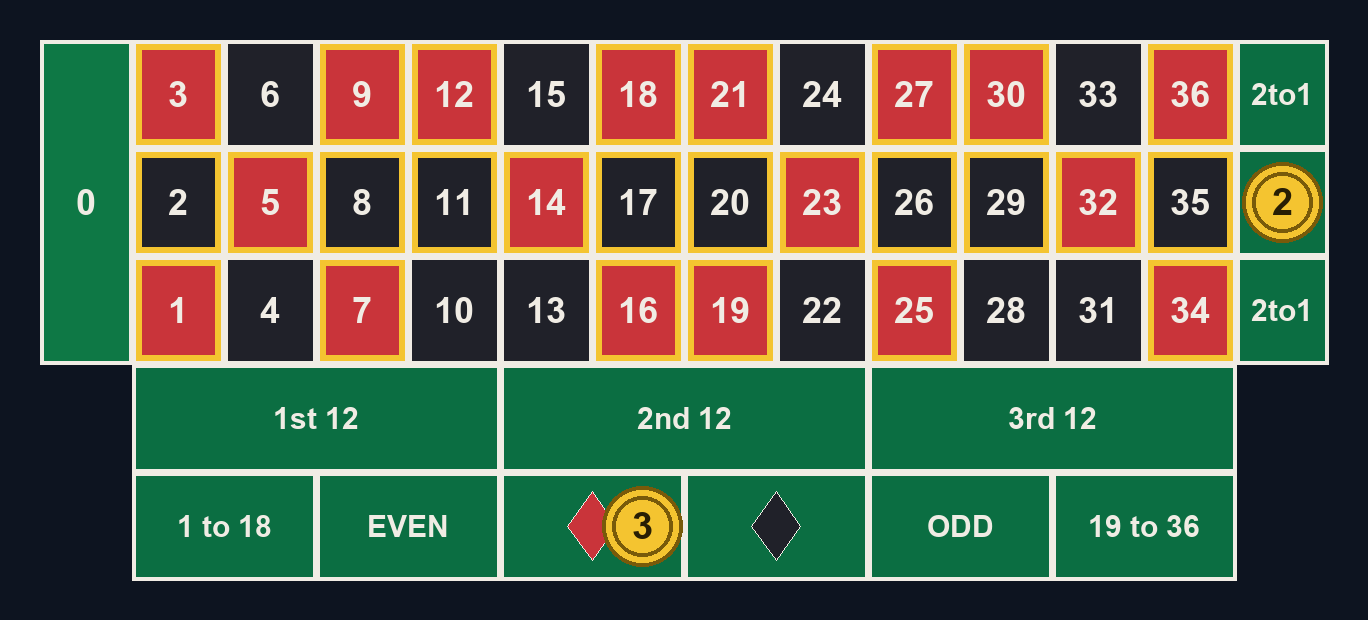
In the classic version the bet is made of two parts. Three units go on red (pays 1:1), two units on the second column (pays 2:1). The total bet per spin is five units. The second column is chosen for a reason: it holds more black numbers than red, so red and the second column barely overlap and together cover the most field. Red covers 18 numbers, the column adds another 12, but some of them are also red and already counted. The smaller the overlap, the wider the coverage.
Why the second column
Let us break the columns of the European wheel down by color.
| Column | Red numbers | Black numbers |
|---|---|---|
| First | 6 | 6 |
| Second | 4 | 8 |
| Third | 8 | 4 |
The second column has only 4 red numbers (5, 14, 23, 32) and 8 black. So red plus the second column overlap on just four numbers: 18 red plus 12 column numbers minus 4 shared give 26 covered cells.
Mirror variant: black and the third column
The layout has a symmetric version. In the third column the picture is reversed - 8 red and 4 black. That means black pairs well with it: three units on black and two on the third column again cover 26 numbers with an overlap of four cells. Both variants are equal: if you want to bet on red, take the second column; on black, the third. Pairing a color with the first column is worse: there red and black are even, the overlap reaches six numbers and coverage drops to 24 cells. More on how columns and dozens behave in the article on dozen and column bets.
Which numbers stay open
With a red plus second column bet, 11 numbers stay outside the coverage: ten black numbers from the first and third columns (4, 6, 10, 13, 15, 22, 24, 28, 31, 33) and zero. Any of them means both bets lose at once.
Zero stands apart. It belongs neither to a color nor to a column, so when zero comes up both bets lose at once - you cannot get part of the chips back, as you can on even-money bets in the French version. It is zero that creates the house edge. How this cell works is in the article on roulette rules.
Outcome math by zone
All 37 numbers split into four zones. The bet is five units.
| Outcome | Numbers | What wins | Result per spin |
|---|---|---|---|
| Red and in the column | 4 | both bets | +7 units |
| Red but not in the column | 14 | color only | +1 unit |
| Column but black | 8 | column only | +1 unit |
| Outside coverage and zero | 11 | nothing | -5 units |
If a number is red and sits in the second column (there are four: 5, 14, 23, 32), both bets win: the color brings 3 units, the column 4, a total of plus 7. Any other red gives plus 3 on color and minus 2 on the column, a net plus 1. A black from the second column is plus 4 on the column and minus 3 on color, again plus 1. Only the 11 open numbers take the whole bet, minus 5.
So 26 of 37 spins end in profit - about 70% of rounds bring either +1 or +7. But a loss costs more than a single win: one minus 5 eats five small pluses. This asymmetry is the catch of frequent coverage.
Why the expected value is still minus 2.7%
Let us add up all outcomes weighted by their frequency. For one spin the expected value is (4 × 7 + 14 × 1 + 8 × 1 - 11 × 5) / 37 = (28 + 14 + 8 - 55) / 37 = -5 / 37 of a unit. That is about minus 0.135 of a unit per spin on a five-unit bet.
Convert to a percentage of the bet: 0.135 divided by 5 gives exactly 1/37, that is 2.70%. This is the standard house edge on the European wheel - the same number as a plain bet on red or on a single column. Wide coverage redistributes results across zones: wins are frequent, losses rare but large. The overall minus stays the same, because it is created by zero, not by the choice of bets. Other systems and their math are in the overview of roulette strategies.
Progressions on top of the system
To offset the rare losses, a progression is sometimes added to the 3 to 2 system - raising the bet after a loss. It looks tempting, but in practice this is the most dangerous part of the scheme.
- With 70% coverage the chance of a loss on one spin is about 30%, but runs of three or four losses in a row happen regularly over the long run.
- Doubling a five-unit bet grows fast: 5, 10, 20, 40, 80 - after five losses in a row the bet is already 80 units.
- Tables have a maximum bet limit that cuts the progression off before it can recover.
A progression does not change the expected value of a single spin - it stays minus 2.7%. It only shifts the risk: many small wins against a rare but painful collapse of the bankroll.
Bankroll management
If you play the 3 to 2 system as a game rather than a source of income, it is wiser to keep a flat bet with no progression and to limit the session in advance.
- A session bankroll is an amount you would not mind losing in full; the bet unit is taken as a small share of the bankroll.
- A loss limit and a win limit are set in advance, and you leave once either is reached.
- A flat bet is more predictable than a progression: losses grow linearly, not in an avalanche.
Watching how tables actually behave is easier with live statistics. In the roulette statistics section you can see how long a given column or color has not come up, across all tables at once.
Conclusion
The 3 to 2 system is a tidy way to spread chips across the field: it covers 26 numbers and gives frequent small returns with a clear bet structure. But coverage does not turn into an edge. The expected value stays at minus 2.7% on the European wheel, every spin is independent, and progressions only raise the risk of a large drawdown. Treat it as a scheme for distributing bets and bankroll, not as a way to beat the casino, and play responsibly.


