 Русский
 English
 हिन्दी
 Türkçe
 Español
 Deutsch
 Italiano
 Français
 Português
 Polski
 中文
 Bahasa Indonesia
 日本語
 বাংলা
 Tagalog
 Ελληνικά
 Български
 Svenska
 Tiếng Việt
 한국어
 Suomi
 Norsk
 Nederlands
 فارسی

The hosts of one YouTube roulette channel take the Romanovsky system with its loud "86% wins" and barely lose spin after spin. It is an 8-unit layout that covers 32 of 37 numbers on the European wheel at once. Let's break down how the chips are placed, why every win brings exactly one unit, where the trap of a high win rate lies and why the expected value is still minus 2.7%.
What the Romanovsky system is
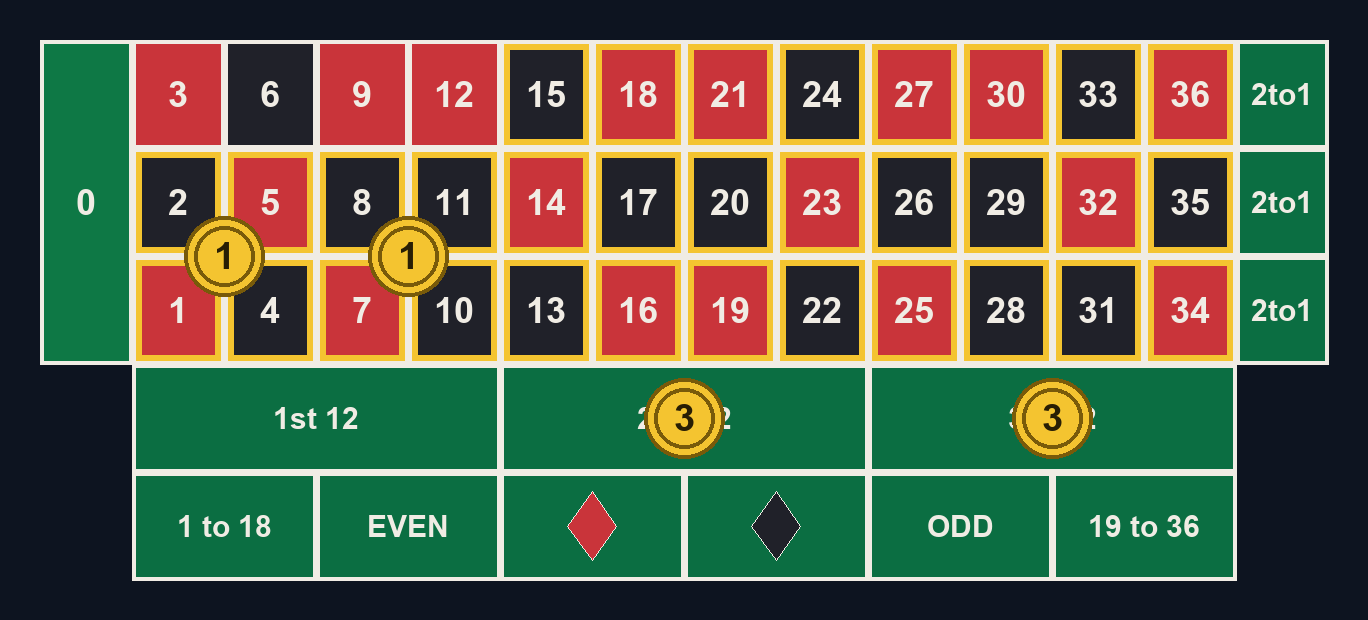
The 8-unit bet is made of three parts: 3 units on the second dozen (13-24), 3 units on the third dozen (25-36) and 1 unit each on two corners (squares) in the first dozen. Each corner covers 4 numbers, two corners cover eight numbers of the first dozen: 1, 2, 4, 5, 7, 8, 10 and 11. Together this covers 32 of 37 numbers. Only four numbers of the first dozen remain uncovered - 3, 6, 9 and 12 - plus zero. What dozens and the corner bet are is explained in the article on dozens and columns.
Why every win brings one unit
The layout is built so that any covered number gives exactly plus one unit - that is the beauty of the system. If a second- or third-dozen number comes up, the winning dozen of 3 units pays 6 on top, while the remaining bets (the other dozen and two corners, 5 units) burn: the net result is plus one unit. If a number on one of the corners comes up, that corner of 1 unit pays 8:1 and returns 9, while all the other 7 units lose: again plus one. And only five numbers - 3, 6, 9, 12 and zero - take the whole 8-unit bet.
86% wins and where the trap is
The win rate really is high: 32 covered numbers of 37 is about 86.5% of spins in profit. But the win is small every time, just one unit, while a rare loss takes eight at once. In other words, one minus cancels out eight previous pluses. A losing streak happens less often than at even odds, but it hits many times harder. The hosts themselves honestly warn: you cannot sit too long with such a system - the longer you play, the more likely a rare loss takes back what you have built up. This is a common property of high-coverage systems, the same we saw with the 3-on-2 system.
Calculating the expected value
Let's add up all outcomes per spin on an 8-unit bet. Thirty-two numbers bring plus one unit each, five numbers - minus eight each. The expected value equals (32 × 1 + 5 × (-8)) / 37 = (32 - 40) / 37 = -8/37 of a unit per spin. That is about minus 0.216 of a unit on a bet of 8, that is exactly 1/37, or 2.70% of the bet. The standard house edge on a single zero - and no layout of 32 numbers removes it, because it is created by the zero, not by the choice of bets. On the American wheel 00 is added as well: there are six losing numbers, and the edge grows to 5.26%, which is why only European roulette suits the system.
Bankroll management
The main risk here is not the size of the bet but time at the table. Since one loss costs eight wins, it is reasonable to set a small goal in advance (for example, to leave after a few pluses) and a hard stop-loss, rather than trying to "spin it out". Adding a progression on top of Romanovsky is dangerous: the bet is already eight units, and doubling after a loss will quickly hit the table limit. A flat bet and a short session are more predictable: you take the frequent small pluses and leave before a rare big loss gives it all back.
How to track before you enter
Since the loss is tied to only five numbers (3, 6, 9, 12 and zero), it is useful to see fresh table statistics. In the roulette statistics section you can see across all tables at once the counters of how long numbers, dozens and sectors have not come up, in real time. This does not change the probabilities, but it helps to assess the system soberly and stop in time, rather than mistaking a lucky streak for a pattern.
Conclusion
The Romanovsky system is a neat 32-number layout with frequent but tiny one-unit wins. Its 86% wins look convincing until you remember that a rare loss costs eight pluses at once. The expected value stays at minus 2.7% on the European wheel: it is created by the zero, not by the coverage of the field. Treat the system as a way to spread the bet and play short sessions, not as a source of income, and play responsibly.