 Русский
 English
 हिन्दी
 Türkçe
 Español
 Deutsch
 Italiano
 Français
 Português
 Polski
 中文
 Bahasa Indonesia
 日本語
 বাংলা
 Tagalog
 Ελληνικά
 Български
 Svenska
 Tiếng Việt
 한국어
 Suomi
 Norsk
 Nederlands
 فارسی

The authors of a YouTube channel about roulette break down an unusual system called Comp Killer. Its twist is that the goal here is not to win but to rack up comps: a free room or dinner from the casino in exchange for a high average bet. We will look at how the chips are placed, how the "theoretical" loss that earns the comps works, and why over the long run this kind of play still runs at a loss.
What the Comp Killer system is
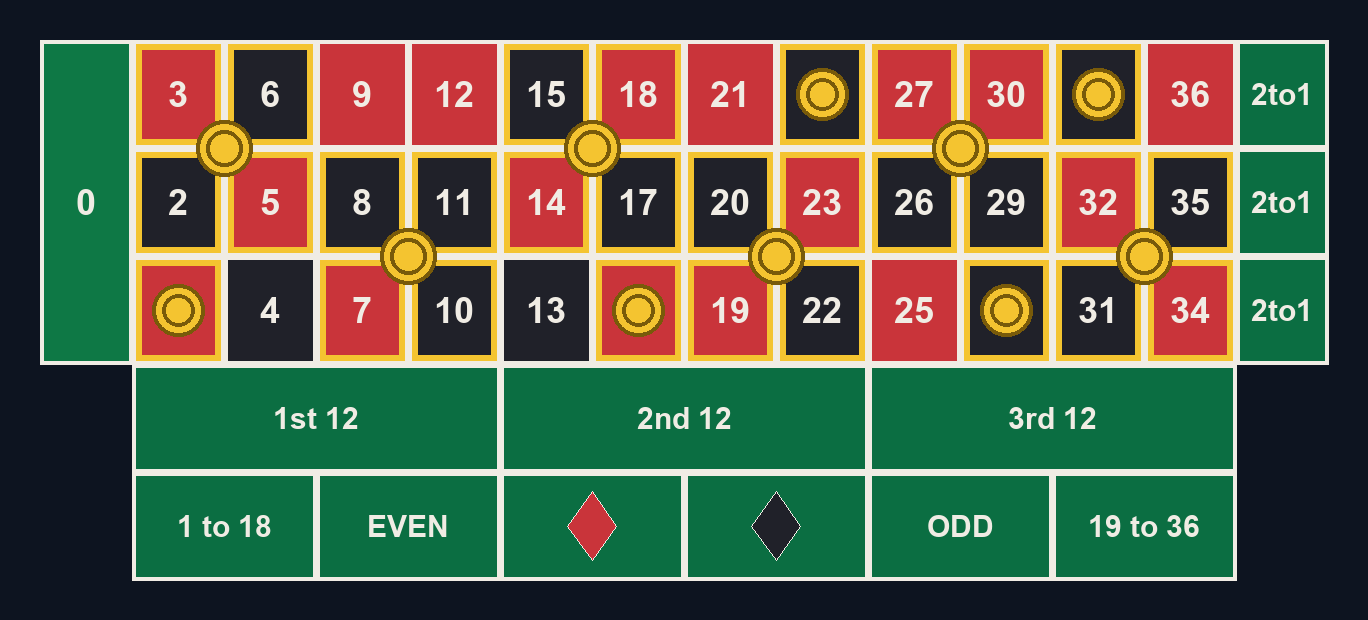
The layout is built from two parts: $5 straight up on each of five numbers (in the video these are 1, 16, 24, 28 and 33) and six corner bets around the field, which the authors call the "rumple". A corner (square) is a bet on four numbers that pays 8:1. The main rule: the straight-up bets must not overlap with the corners. In total about $175 ends up on the table per spin - a large average bet that covers roughly 29 of the 37 numbers. The specific corners can be shifted around the field, and the pattern stays similar. What a corner and a straight-up bet are is covered in the rules of roulette.
The main idea is not winning but comps
Comp Killer is honestly built not around profit but around casino comps. The casino awards bonuses (a free room, dinner, transfer) based on your "theoretical" - the product of your average bet and your time at the table. The higher the average bet and the longer the session, the bigger the theoretical loss and the more generous the comps. Hence the logic of the system: keep the average bet around $175, play at a busy table where there are fewer spins per hour, and simply stretch out the time. The authors say it outright: the goal is to sit through a three-hour session and get a free room.
Why comps do not make the play profitable
The problem is that comps are only a part of your expected loss, not a gift on top of it. The casino usually returns only a small share of the theoretical as bonuses and keeps the rest - that is what the whole mechanism rests on. Roulette has the highest "theoretical" among the tables precisely because the house edge here is large. In other words, you pay for the room not with money directly but with an expected loss that is almost always greater than the cost of that room.
The math: how much a free room costs
Let us run the numbers. An average bet of $175, a house edge of 2.7% on the European wheel. The expected loss per spin is 175 x 0.027, about $4.7. At a busy table you get roughly 40 spins per hour, so over a three-hour session about 120 spins. That gives an expected loss of about 120 x 4.7 = $560. For that the casino might give a room worth $150-300. So you are "buying" a $300 room at the price of an expected loss of about $560 - twice what it is worth. On the American wheel with two zeros the edge is 5.26%, and the loss nearly doubles. In other words, the free room is paid for not by the casino but by you - just not directly out of pocket, but through the lost bets that over three hours of play you often do not even notice.
What is reasonable here and what is not
If you were going to play roulette anyway, then structuring your bets for comps is not the worst idea: at least you get something back. But playing specifically for comps is a guaranteed loss: the expected loss is consistently higher than the value of the bonus. And if comps really are the goal, they come cheaper on games with a low house edge, not on roulette, whose edge is one of the highest. There is a piece on the edge itself and the return in the article on roulette RTP.
How to track before you sit down
Since the layout covers a large part of the field, it helps to see fresh table statistics. In the roulette statistics section you can see, across all tables at once, real-time counters of how long numbers, sectors and corners have not come up. This does not change the probabilities and does not make the play profitable, but it helps you judge the system soberly and not confuse collecting comps with winning.
Conclusion
Comp Killer is more honest than many systems if only because it does not promise a win: its job is to convert play into comps. But the arithmetic is merciless: the expected loss per session noticeably exceeds the cost of a free room, and on roulette it is also one of the highest among the tables. The expectation stays at minus 2.7% on the European wheel. Treat the system as a way to structure your play if you are playing anyway, not as a path to getting something for free, and play responsibly.