 Русский
 English
 हिन्दी
 Türkçe
 Español
 Deutsch
 Italiano
 Français
 Português
 Polski
 中文
 Bahasa Indonesia
 日本語
 বাংলা
 Tagalog
 Ελληνικά
 Български
 Svenska
 Tiếng Việt
 한국어
 Suomi
 Norsk
 Nederlands
 فارسی

The creators of one YouTube roulette channel take the Double Street Martingale system: a bet on five double streets that covers 30 of 37 numbers, with Martingale on top. It looks almost risk-free - four out of five spins end in profit. Let's break down how the chips are placed, why every win brings just a single unit, how doubling after a loss sets a trap and why the expected value stays at minus 2.7%.
What this system is
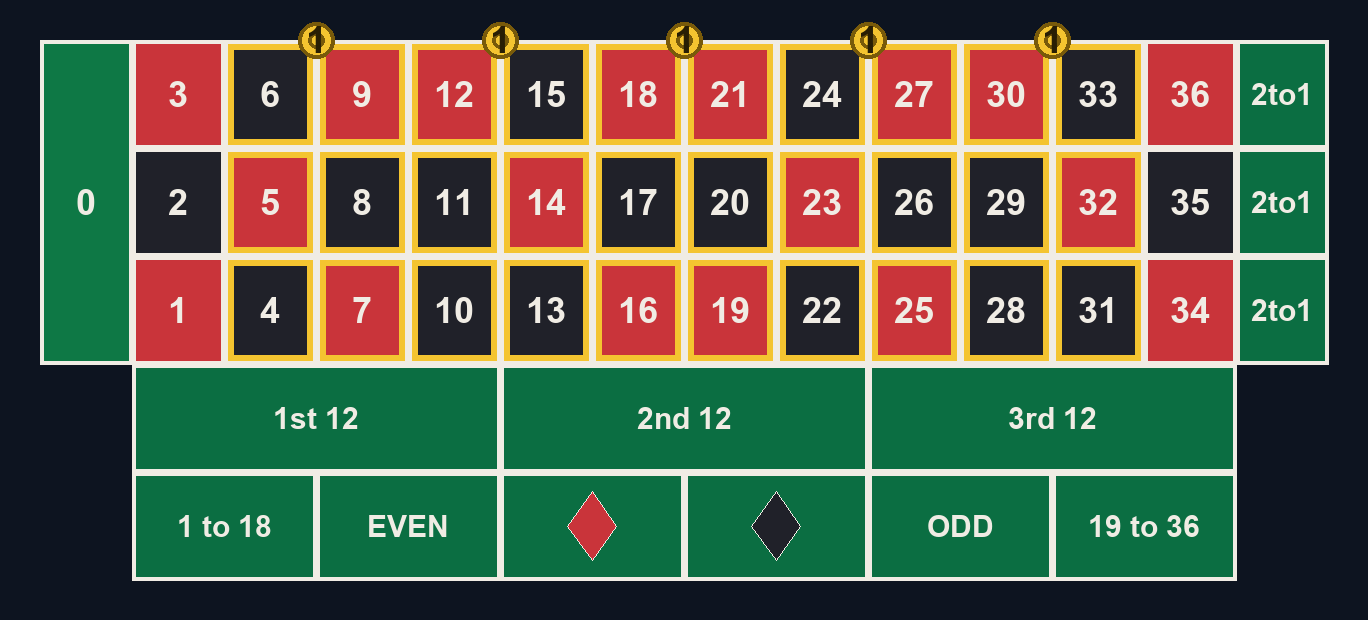
A double street (a six line) is a bet on six adjacent numbers that pays 5:1. In this system you play exactly five double streets: 4-9, 10-15, 16-21, 22-27 and 28-33. Together they cover 30 of 37 numbers - every number from 4 through 33. Only 1, 2, 3, 34, 35, 36 and zero are left uncovered. One unit on each double street, five units per spin in total. These five double streets are the only ones possible on the layout, with no variations or rearrangements. You can find what a six line and other bets are in the roulette rules.
Martingale on top of the coverage
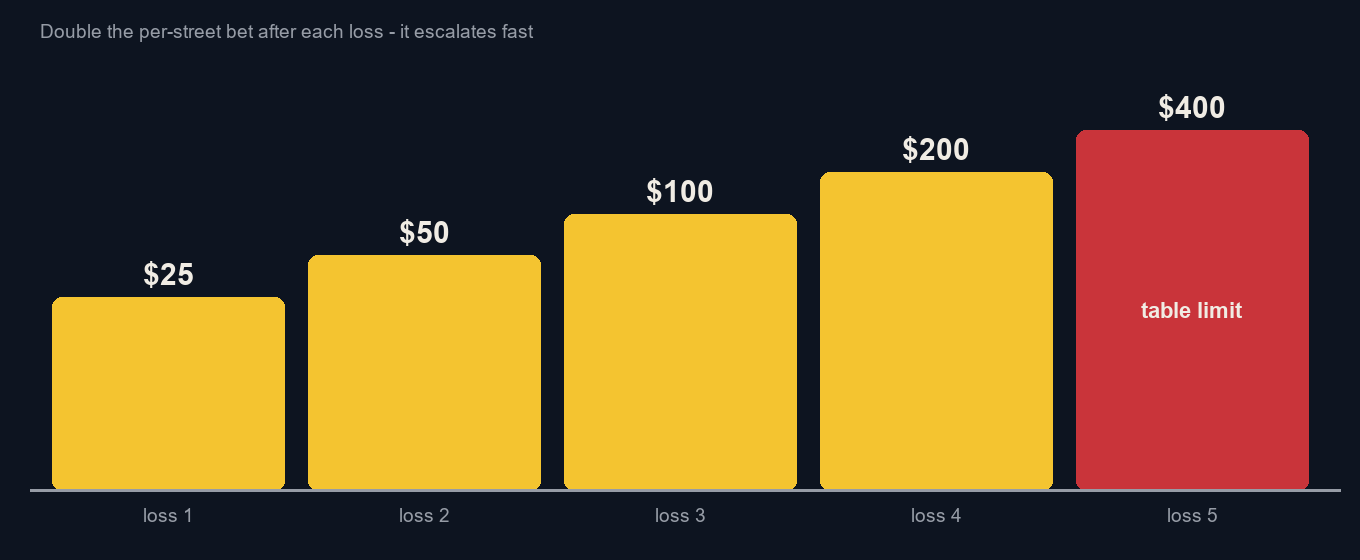
As long as the spins win, each hit brings plus one unit: the winning double street of 1 unit pays 5:1 and returns 6, while the other four burn up. But the moment one of the seven uncovered numbers lands, all five units are lost at once. This is where Martingale kicks in: after a loss the bet on each double street is doubled. In the version discussed that is 25, then 50, then 100 dollars per double street, and after a recovery you go back to the start. The problem is that the doubling grows like an avalanche.
81% wins and the Martingale trap
The win rate is high: 30 covered numbers out of 37 is about 81% of spins in profit. But the win is always just a single unit, while a loss takes the whole round. At 19% to lose, a run of two or three losses in a row happens regularly, and the doubling quickly accelerates the bet: 25, 50, 100, 200, 400 dollars per double street. Five double streets at 400 is already 2000 per spin, and the table limit cuts off the progression before the run has time to recover. The expected value does not change in the process. Per spin at a 5-unit bet it equals (30 × 1 + 7 × (-5)) / 37 = (30 - 35) / 37 = -5/37, that is exactly 1/37, or 2.70% of the bet. This is the same single-zero house edge as on any other layout. There is a separate breakdown of Martingale on the doubling mechanism itself.
The modification: positive Martingale
The authors suggest a milder option: first build up profit with regular play, and then press the bet using only what has been won - the so-called positive Martingale. There is a sensible kernel here: you are no longer risking your own bankroll but your winnings, and you are not chasing a recovery. But this too does not change the math: each individual spin still carries minus 2.7%, and the positive progression only increases the variance - you can walk away with a big profit, or give back all the profit you built up with a single loss.
Bankroll management
The main danger is precisely the negative Martingale: it requires a large bankroll and still runs into the table limit. It is more sensible to keep a flat bet without doubling: losses then grow linearly rather than like an avalanche. Set a stop-loss and a win target in advance and leave once either one is reached. If you do try the modification, do it strictly with money you have won and with a hard session limit, without returning your original bankroll to play.
How to track before you enter
Since the loss is tied to just seven numbers (1, 2, 3, 34, 35, 36 and zero), it helps to see fresh table statistics. In the roulette statistics section you can see across all tables at once the counters for how long numbers, sectors and field edges have not come up, in real time. This does not change the probabilities, but it helps you assess the system soberly and stop in time, rather than waiting until a rare run of losses sets off the doubling avalanche.
Conclusion
The Double Street Martingale is broad coverage of 30 numbers plus classic Martingale on top. The high 81% win rate looks convincing until a losing run triggers the doubling, which runs into the table limit. The modification that plays with money already won is safer, but it does not create an advantage either: the expected value stays at minus 2.7% on the European wheel because of the zero. Treat the system as a way to distribute your bet and manage risk, not as a path to beat the casino, and play responsibly.