 Русский
 English
 हिन्दी
 Türkçe
 Español
 Deutsch
 Italiano
 Français
 Português
 Polski
 中文
中文 Bahasa Indonesia
 日本語
日本語 বাংলা
বাংলা Tagalog
 Ελληνικά
 Български
 Svenska
 Tiếng Việt
 한국어
한국어 Suomi
Suomi Norsk
Norsk Nederlands
 فارسی
فارسی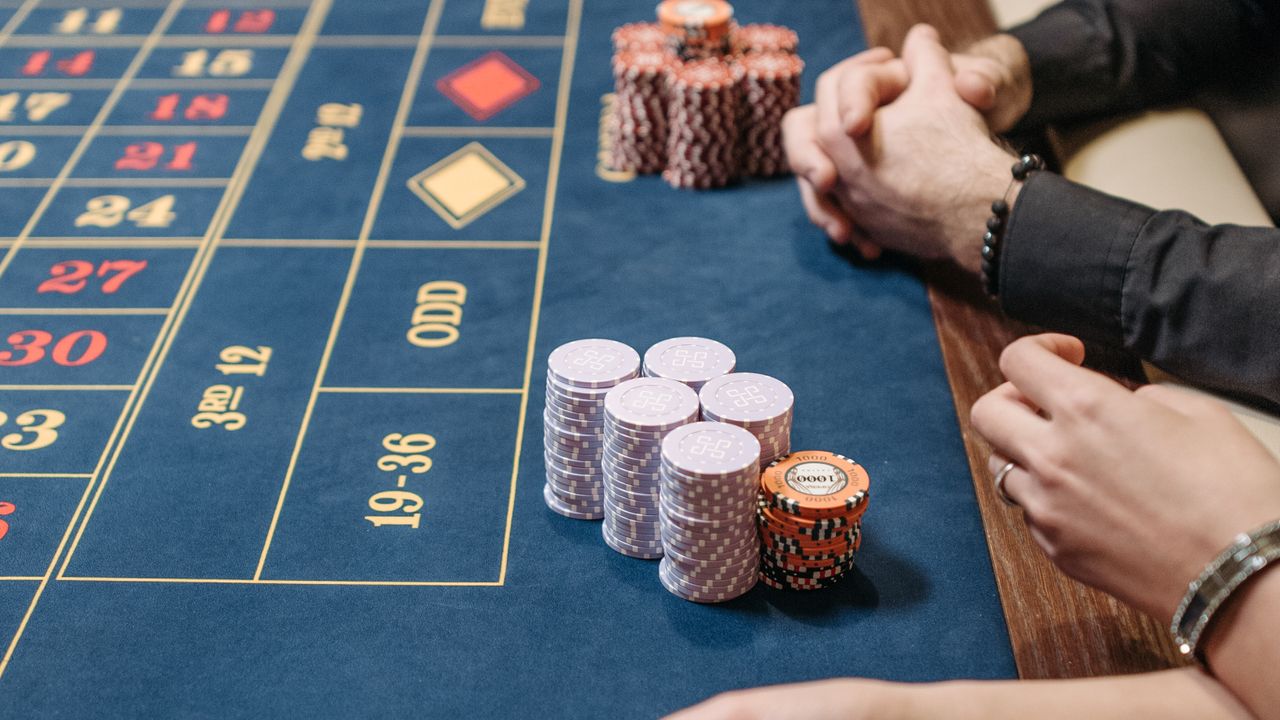
The roulette strategy on dozens and columns is built on bets that cover a whole third of the playing field at once and pay 2:1. Bets on columns work by the same logic, only the numbers are grouped not in order but by the three vertical rows of the table. The dozens and columns strategy appeals because a single winning bet covers 12 numbers out of 37, and when playing two sectors there are already 24 numbers under the bet. Below we break down the maths of these bets, their combinations, progressions and the honest limits of the approach without promises of income.
What dozens and columns are
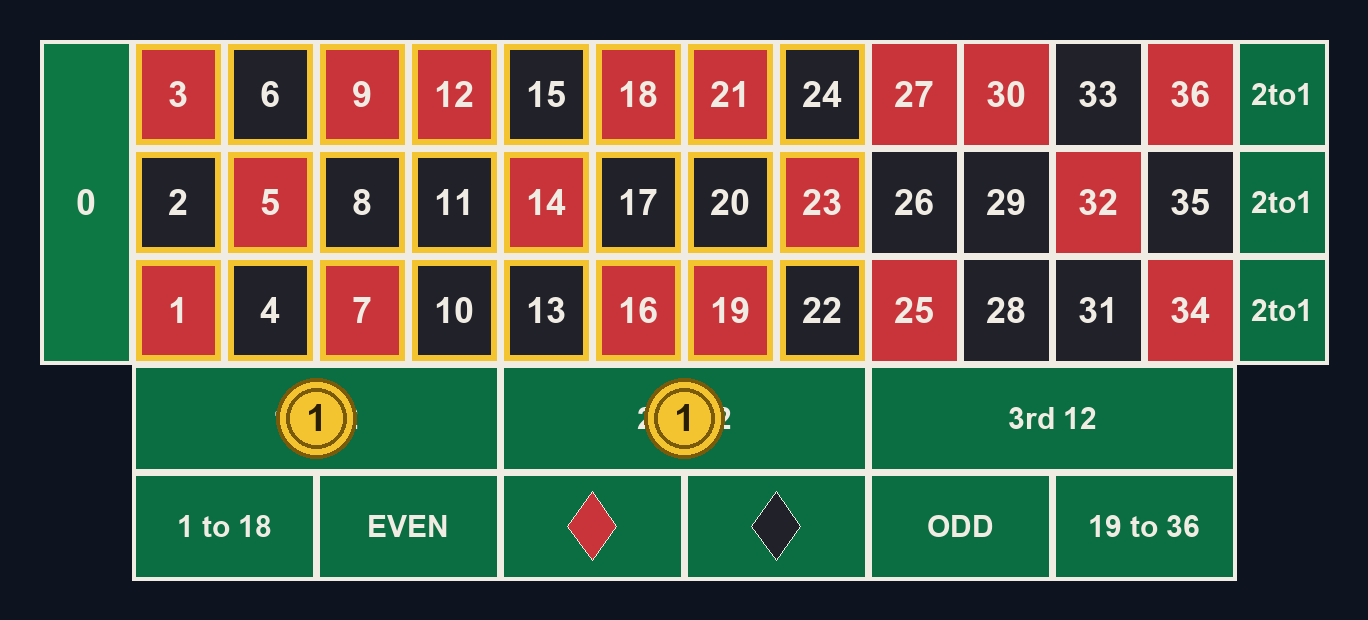
The playing field of European roulette contains the numbers from 0 to 36. The numbers 1 to 36 are divided into three dozens: the first (1-12), the second (13-24) and the third (25-36). Each dozen is 12 consecutive numbers with its own zone on the field.
Columns are the three vertical rows of the number table, also 12 numbers each: 1, 4, 7 and so on in the first, 2, 5, 8 in the second and 3, 6, 9 in the third. Unlike dozens, the numbers in a column do not run in order but are scattered across the whole field. The zero (0) belongs to no dozen and no column, and this is exactly the source of the house edge. The basic notation of the zones is handy to refresh in the article on the rules of roulette.
Probability and payout
A dozen and a column pay the same - 2:1. On a winning bet of 1 unit you receive 2 units of profit plus the return of the bet. The sector covers 12 numbers out of 37, so the chance of hitting equals 12/37, about 32.4%. A loss, including the zero, occurs in 25 cases out of 37, about 67.6%.
The mathematical expectation here, (12/37) multiplied by (+2) plus (25/37) multiplied by (-1), gives -1/37, that is -2.7% of the bet. This is the house edge of the European wheel, and it does not change under any scheme of bets on dozens and columns.
| Bet type | Numbers covered | Probability | Payout |
|---|---|---|---|
| One dozen | 12 | 32.4% | 2:1 |
| One column | 12 | 32.4% | 2:1 |
| Two dozens | 24 | 64.9% | 2:1 on the winner |
| Dozen plus column | 20 | 54.1% | 2:1 on each |
Betting on two dozens or two columns
The most discussed option is a simultaneous bet on two of the three dozens or on two columns. This puts 24 numbers out of 37 under the bet, a win probability of 64.9%. It looks reliable, but it is important to understand how the risk-to-profit ratio changes.
Suppose you bet 1 unit each on two dozens, 2 per spin in total. If a number from either of your dozens comes up, the winning bet brings 2 units of profit, but the second burns out, and the net result of a lucky spin is plus 1 unit. If a number of the third dozen or the zero comes up (13 numbers out of 37), you lose both bets, minus 2 units.
The result is an asymmetry: you often win little (+1) and less often lose twice as much (-2). The expectation: (24/37) multiplied by (+1) plus (13/37) multiplied by (-2) gives -2/37 per spin, the same -2.7%. A high win frequency does not remove the house edge, it merely redistributes the result toward frequent small pluses and rare painful minuses. Two columns work the same way.
The dozen plus column combination
A more flexible scheme is to combine one dozen and one column. Each column passes through all three dozens, so a dozen and a column always have an overlap of 4 numbers. For example, the first dozen (1-12) and the first column overlap in the numbers 1, 4, 7 and 10. The total coverage is 12 plus 12 minus 4 overlapping, that is 20 numbers out of 37, about 54.1%.
The value of the combination is in the different payout levels depending on where the ball landed:
- a hit in the overlap (4 numbers) - both bets win, profit +4;
- a hit in the dozen or the column separately (16 numbers) - one bet wins, the other burns out, profit +1;
- a miss (17 numbers, including the zero) - both bets lost, minus 2 units.
The expectation stays the same: (4/37) multiplied by (+4) plus (16/37) multiplied by (+1) plus (17/37) multiplied by (-2) gives -2/37 per two units, the same -2.7%. The combination gives a more jagged chart with rare large pluses on the overlap, but the overall maths does not change.
Progressions on dozens and their danger
To smooth over losses, progressions are often added to bets on dozens, that is, a chase: after a loss the bet is increased so that a single win returns the losses. Because of the 2:1 payout the step grows less sharply than when doubling on even-money chances, but the trap is the same.
A single dozen loses roughly 2 cases out of 3, so streaks of 4-6 losses in a row are common. Already on the fifth or sixth loss the bet runs into the table limit or the remainder of the bankroll, and one such failure takes more than dozens of previous returns.
| Spin | Bet | Accumulated minus | Profit on a win |
|---|---|---|---|
| 1 | 1 | 0 | +2 |
| 2 | 2 | -1 | +3 |
| 3 | 4 | -3 | +5 |
| 4 | 8 | -7 | +9 |
| 5 | 16 | -15 | +17 |
A separate mistake is chasing a cold dozen that has not come up for a long time. The wheel has no memory: past spins do not change the probability of the next one, it is always 12/37. Tracking streaks of non-appearance is useful for discipline, but it does not raise the odds. More on working with such data - in the piece on reading roulette statistics.
Bankroll management
For enjoyment it is wiser to give up aggressive chases in favour of flat bets and hard limits. The basic rules are simple:
- the size of a single bet is 1-2% of the bankroll, so that a losing streak does not knock you out of the game;
- a preset stop-loss (for example, minus 20 units) and a stop-profit after which the session closes;
- a fixed number of spins per session instead of playing until you recover;
- an understanding that at -2.7% over distance the balance on average declines, and this is the price of entertainment.
This approach does not turn bets into a source of income, but it keeps the risk under control.
An honest conclusion
The dozens and columns strategy is a way to structure your bets and choose the balance between the frequency and the size of your wins, not a method to beat the casino. Any scheme on the 2:1 field keeps the house edge at 2.7% on the European wheel and higher on the American one because of the second zero. High coverage lowers the spread of results but symmetrically reduces the payout, leaving the expectation negative.
A breakdown of other systems and their honest limitations is gathered in the review of roulette strategies. It is convenient to follow the spin history, the frequency of dozens, columns and sectors on live tables in the free roulette statistics tracker: this helps with discipline but does not change the probabilities of each spin.


