 Русский
 English
 हिन्दी
 Türkçe
 Español
 Deutsch
 Italiano
 Français
 Português
 Polski
 中文
中文 Bahasa Indonesia
 日本語
日本語 বাংলা
বাংলা Tagalog
 Ελληνικά
 Български
 Svenska
 Tiếng Việt
 한국어
한국어 Suomi
Suomi Norsk
Norsk Nederlands
 فارسی
فارسی
In one popular roulette video, the authors ran a system over a thousand spins and lost only once, calling it a “99.999% win rate”. It sounds impressive, but behind the figure lies an ordinary bet on two dozens with an aggressive progression. Let’s break down how the chips are placed, what betting sequence is used, why a single loss eats up dozens of wins, and what bankroll you need so a short lucky streak doesn’t fool you.
What this system is
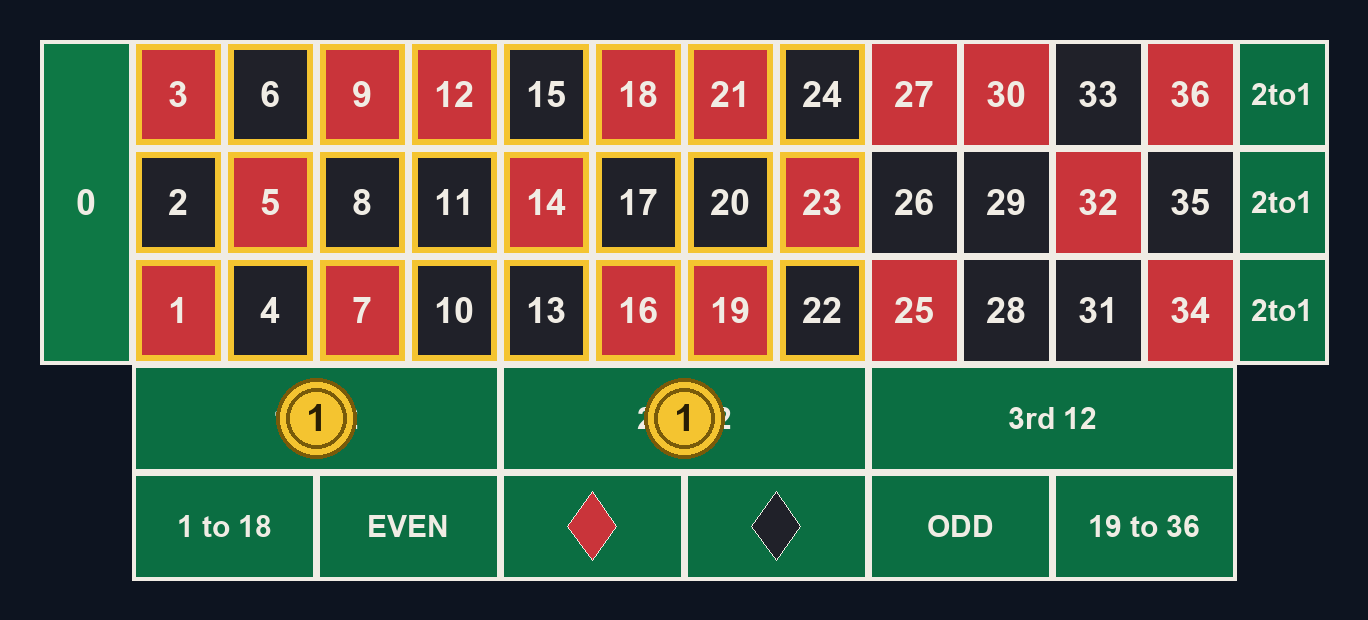
The system belongs to the dozen bets. On the table, the numbers 1 to 36 are split into three dozens of 12 numbers each, and a dozen pays 2 to 1. Here the bet goes on two of the three dozens at once, so 24 of the 37 numbers are covered. That is about 64.9% of the field per spin, which is where the sense of frequent wins comes from. Importantly, these are two separate bets: one dozen can win while the other loses. We covered the mechanics of dozens and columns themselves in a separate article.
The progression: the betting sequence
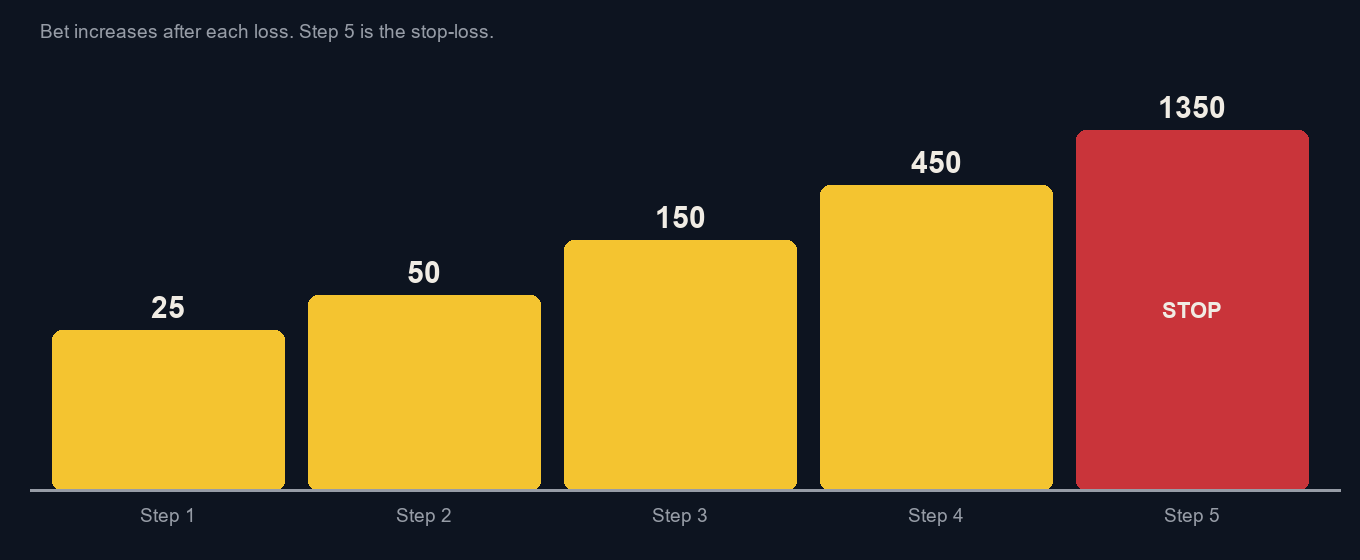
While the spins keep winning, the player holds the minimum bet. After a loss a Martingale-style progression kicks in, but not a simple doubling - a steeper step. In the version analysed, the sequence is as follows:
- step 1: 25
- step 2: 50
- step 3: 150
- step 4: 450
- step 5: 1350 (stop-loss)
- step 6 (optional): 4050
The step being steeper than a doubling is no accident. With a bet on two dozens, a win covers only one of them, so the net profit of a successful spin equals one betting unit. To recover the loss on both bets at once, each next round has to be increased roughly threefold rather than twofold. The authors advise stopping at the fifth step and leaving the session within 7-15 spins.
Why 99.999% is an illusion
The result of “one miss per thousand spins” was obtained in a simulator over a short distance and in a lucky run. The problem with the progression is not how often the losses happen but how much they cost. With 24 numbers covered, a loss at a given level is rare, around 35% per spin, but a streak of five or six failures in a row happens regularly. One such break at the fifth step carries away the amount built up by dozens of small gains. The expected value does not change in the process: on the European wheel it stays at minus 2.7% because of the zero, and no chip layout cancels that percentage. On the progression mechanism itself and its traps there is a separate breakdown of the Martingale.
Calculation by zones
Take a bet of one unit on each of the two dozens, two units per spin in total. If a number from either of your dozens comes up (24 outcomes), the winning bet brings 2 units, the second burns out, and the net result is plus one unit. If a number from the third dozen or the zero comes up (13 outcomes), both bets lose, minus two units. The result is an asymmetry: many small pluses of one unit each against rare minuses that, against the backdrop of the progression, become large.
A short winning streak looks convincing precisely because of the frequent small pluses: while the dozens alternate favourably, the balance grows in small steps and it seems the system works. But that is a property of the coverage, not a player’s edge, and over distance the rare break in the progression returns the result to the same negative value.
Bankroll management and limits
The main risk of the system is the table limit and the size of the bankroll. The progression 25-50-150-450-1350 already requires 1350 per spin by the fifth step, and the sixth step runs into the maximum of many tables before the streak has a chance to recover. That is why the stop-loss is fixed in advance and you exit once it is reached, without trying to “chase it back”. It is safer to play a flat bet without a progression: the losses then grow linearly rather than like an avalanche. The session bankroll is taken with a margin of 15-20 spins, and both the loss and the win are capped in advance.
How to track the dozens
Before entering it helps to see how long each dozen has gone without coming up and how often they alternate. In the roulette statistics section this is visible across all tables at once: the miss counters for dozens, columns and colours update in real time. This does not raise your chances, but it helps to assess the system soberly and not take a short streak for a pattern.
Conclusion
The two-dozen system with a progression is a neatly packaged Martingale, where the loud figure of “99.999%” describes a lucky run rather than a real edge. Covering 24 numbers gives frequent small wins, but the rare break in the progression outweighs them all, while the expected value stays at minus 2.7%. Treat it as a scheme for distributing bets with a hard stop-loss, not as a way to beat the casino, and play responsibly.