 Русский
 English
 हिन्दी
 Türkçe
 Español
 Deutsch
 Italiano
 Français
 Português
 Polski
 中文
 Bahasa Indonesia
 日本語
 বাংলা
 Tagalog
 Ελληνικά
 Български
 Svenska
 Tiếng Việt
 한국어
 Suomi
 Norsk
 Nederlands
 فارسی

Yet another popular system is pitched by the authors of one YouTube roulette channel almost as "you can't lose": frequent hits and "jackpots" one after another. This is Holy Splits - a free-flowing scheme of split bets around the middle column. Let's break down how the chips are placed, what the authors call a jackpot, and why the expected value stays at minus 2.7% no matter what.
What the Holy Splits system is
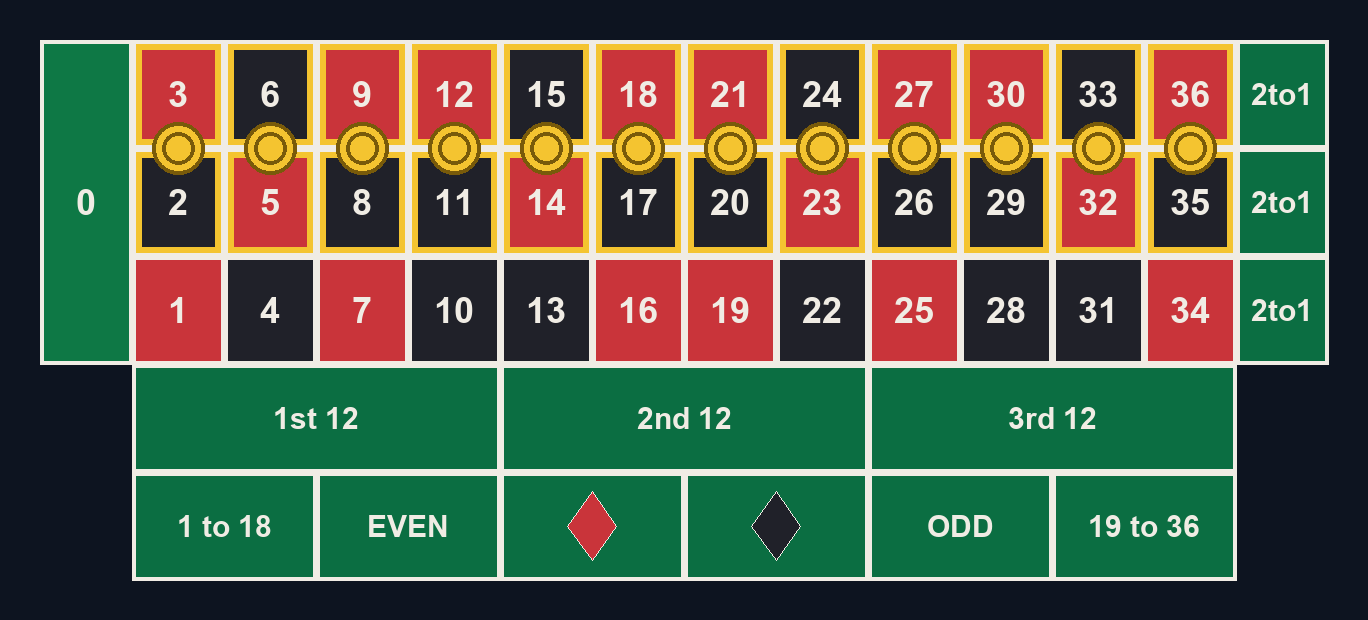
The system is presented as "free-flowing": you take 12 splits, each of which touches the middle (second) column. A split is a bet on two adjacent numbers that pays 17:1. Since all 12 splits are concentrated around the middle column, together they cover about 24 of 37 numbers. The middle-column numbers where several splits meet at once are what the authors call jackpots, and their neighbours - ordinary hits. The numbers at the edge of the layout and the zero stay uncovered. The exact arrangement can vary - that is the point of a "free-flowing" scheme. What a split and the other bets are is covered in the rules of roulette.
Why splits and why the middle column
A split is placed on the line between two adjacent numbers and wins if either of them comes up, paying 17:1. It is a compromise between a straight-up bet on a single number (35:1, but only one number is covered) and wide even-money bets: a split covers two numbers at once and pays noticeably more. The middle column was not chosen at random: the greatest number of adjacent splits pass through its numbers - above, below and to the sides - so it is convenient to gather twelve bets around it in such a way that some of them overlap on the same numbers. The more splits that meet on a number, the bigger the payout when it comes up - hence the division into ordinary hits and jackpots. But overlaps only redistribute the winnings between numbers; they add no advantage for the player.
Hits, jackpots and losses
Each spin has three possible outcomes. In roughly a third of cases an ordinary covered number comes up - one split wins, the rest burn, and you get a small plus. In roughly another third a middle-column number comes up - if two splits meet on it, the payout doubles, and that is the jackpot. And about a third of spins, including the zero, miss - all the splits lose at once. The authors advise leaving once you reach a target win or after three losses in a row - a sensible rule to avoid giving back all the profit you have built up.
Why jackpots do not change the math
The nice word "jackpot" only describes a doubled payout on a number where two splits meet, but it does not change the house edge. A split pays 17:1, and however you arrange the 12 splits, the expected value of each number adds up to the same figure. On the European wheel that is minus 2.7% because of the zero: it is precisely the zero pocket that is not covered by any split and that creates the edge. Wide coverage makes wins frequent and losses rare, but a rare loss takes all 12 bets at once. The same logic as with the 3 to 2 system and other coverage schemes: the distribution of outcomes changes, the house edge does not.
How much it costs per spin
Twelve splits is a sizeable bet for a single round, and it is easy to underestimate. If you stake one unit per split, that is already 12 units in play per spin, and a streak of three or four losses in a row, which happens regularly over distance, quickly eats into the bankroll. Adding a progression on top of Holy Splits is risky: the bet is already large, and doubling will run into the table limit. It is safer to keep a flat bet and set both a target and a stop-loss in advance. For more on spreading bets across the layout, see the article on dozens and columns.
How to track before you enter
Since the result depends on how often the middle column and the uncovered edges come up, it helps to see fresh statistics. In the roulette statistics section you can see, across all tables at once, real-time counters of how long numbers, columns and sectors have been absent. This does not change the probabilities, but it helps you assess the system soberly and not mistake a lucky run of jackpots for a pattern.
Conclusion
Holy Splits is a neatly packaged bet on splits around the middle column: frequent hits, flashy "jackpots" and rare but painful losses. Coverage of about 24 numbers gives a sense of control, but the jackpots do not override the math: on the European wheel the expected value stays at minus 2.7% because of the zero. Treat the system as a way to spread your bet across the layout with frequent returns, not as a source of income, and play responsibly.


