 Русский
 English
 हिन्दी
 Türkçe
 Español
 Deutsch
 Italiano
 Français
 Português
 Polski
 中文
 Bahasa Indonesia
 日本語
 বাংলা
 Tagalog
 Ελληνικά
 Български
 Svenska
 Tiếng Việt
 한국어
 Suomi
 Norsk
 Nederlands
 فارسی

The hosts of one YouTube channel about roulette show how to turn 5 dollars into 1200, as if they had hit a jackpot on a slot machine. This is the Ride or Die system in its Power Press Collect version - a positive progression: you build up your bet out of your winnings and, in the final step, bet on a single number. Let's break down how press and collect work, why a full run up to 1200 is a lottery, and why the expected value is still minus 2.7%.
What this system is
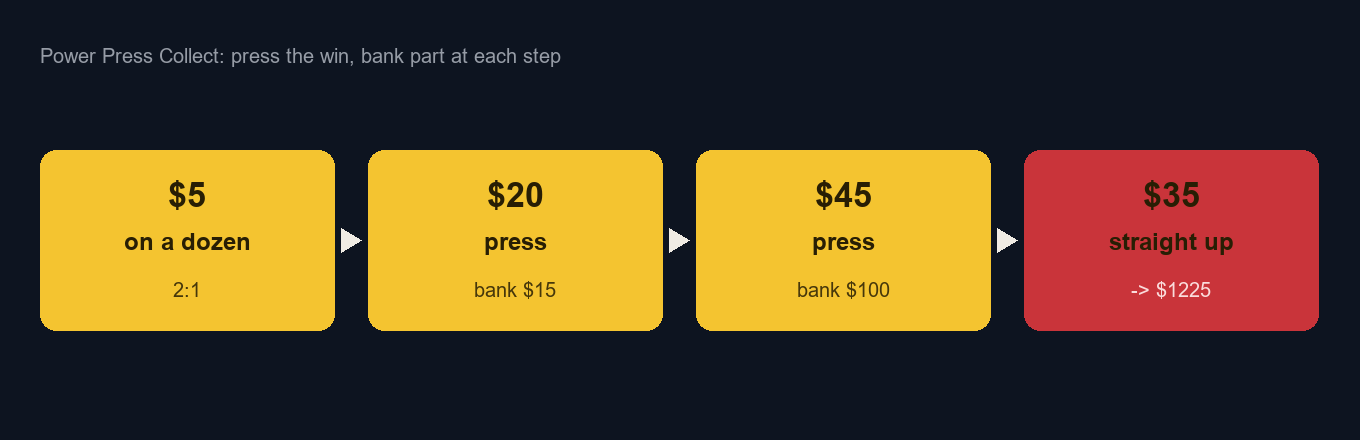
The start is a small bet on a dozen (you can use two dozens, or a dozen plus a column), paying 2:1. The logic in a nutshell: press means increasing your bet out of the payout after a win, while collect means setting part of the profit aside right away. The classic sequence: 5 on a dozen, on a win you press up to 20, on the next one you take part of it and bet 45, and in the final step you move what is left onto a single number (paying 35:1). A hit on a number with 35 dollars yields about 1225 - that same "jackpot". Players leave the game as soon as the single number comes in. There is a separate article about dozens and columns themselves.
Press and collect: what they mean
Press is ramping up the bet, when you add part of a win to the next round and play with the casino's money rather than your own. Collect is the opposite discipline: at each step you withdraw part of the profit and tuck it away, so that a losing streak cannot take everything back. Collect is exactly the soundest thing in this system: it locks in part of the win and keeps you from giving it back. But on their own, neither press nor collect creates an edge - they only manage the size of the bet.
Two rounds at once: wider coverage, higher risk
In the video the hosts often run not one but two bets in parallel: two dozens, or a dozen plus a column, developing each one separately. The idea is to give yourself more paths to the finish: while one chain breaks off, the other may keep going. But it is a double-edged sword: per spin you bet twice as much, and in a bad round you lose twice as fast too. Parallel progressions do not add up to an edge - they only increase both the spread of the result and the speed at which the bankroll melts away. To control risk it is wiser to run a single chain and keep a strict session limit.
Why 1200 is a lottery
To reach the final 1225 you need to win three dozen bets in a row and then hit a single number. Let's estimate the probability on a European wheel. A dozen wins in 12 cases out of 37, about 32.4%. Three dozens in a row is 0.324 to the third power, roughly 3.4%. That is, only in three percent of rounds will you even reach the final throw. And hitting a single number is 1 in 37, about 2.7%. The upshot: a full run to 1225 happens in about 0.09% of cases, that is once in more than a thousand attempts. Most sessions break off already at the first or second step. The nice story about 5 dollars and a jackpot is a rare lucky run, not an earning scheme.
What is sensible and what is not
What is sensible here is the collect habit: taking part of the win and not returning it to play. It does not improve the odds, but it protects what has already been won. What is unwise is chasing the big single-number hit, betting everything on one number: the probability is small and the expected value is negative. A progression on top of a progression only speeds up both wins and losses. The difference from the Martingale is that here you build up your bet on wins rather than on losses, but the outcome is the same: the expected value on a single zero stays at minus 2.7%, and neither press nor collect changes it.
How to track before entering
The start of the system depends on how the dozens and columns are running right now. In the roulette statistics section you can see, across all tables at once, the counters for how long dozens, columns and numbers have not come up, in real time. This does not improve the odds, but it helps you assess the system soberly and not mistake a short lucky streak for a pattern.
Conclusion
Power Press Collect is a neatly packaged positive progression with the discipline of withdrawing part of the profit. On the plus side is the habit of locking in a win; on the minus side is the final bet on a single number for 1225, which comes off about once in a thousand attempts. Coverage and nice words do not cancel the math: on a European wheel the expected value stays at minus 2.7% because of the zero. Treat the system as a way to manage your bet and lock in profit, not as a path to a jackpot, and play responsibly.


