 Русский
 English
 हिन्दी
 Türkçe
 Español
 Deutsch
 Italiano
 Français
 Português
 Polski
 中文
中文 Bahasa Indonesia
 日本語
日本語 বাংলা
বাংলা Tagalog
 Ελληνικά
 Български
 Svenska
 Tiếng Việt
 한국어
한국어 Suomi
Suomi Norsk
Norsk Nederlands
 فارسی
فارسی
The James Bond strategy is a fixed betting layout of 200 units that covers 25 of the 37 numbers on European roulette in a single spin. In its basic form the James Bond system in roulette uses no progression: you bet the same amount every round (flat-bet) and make a profit on any number from 13 to 36 and on zero. Below we break down the exact layout across three zones, which numbers stay open, how much each zone pays and why covering the field does not remove the house edge.
The layout: 140, 50 and 10
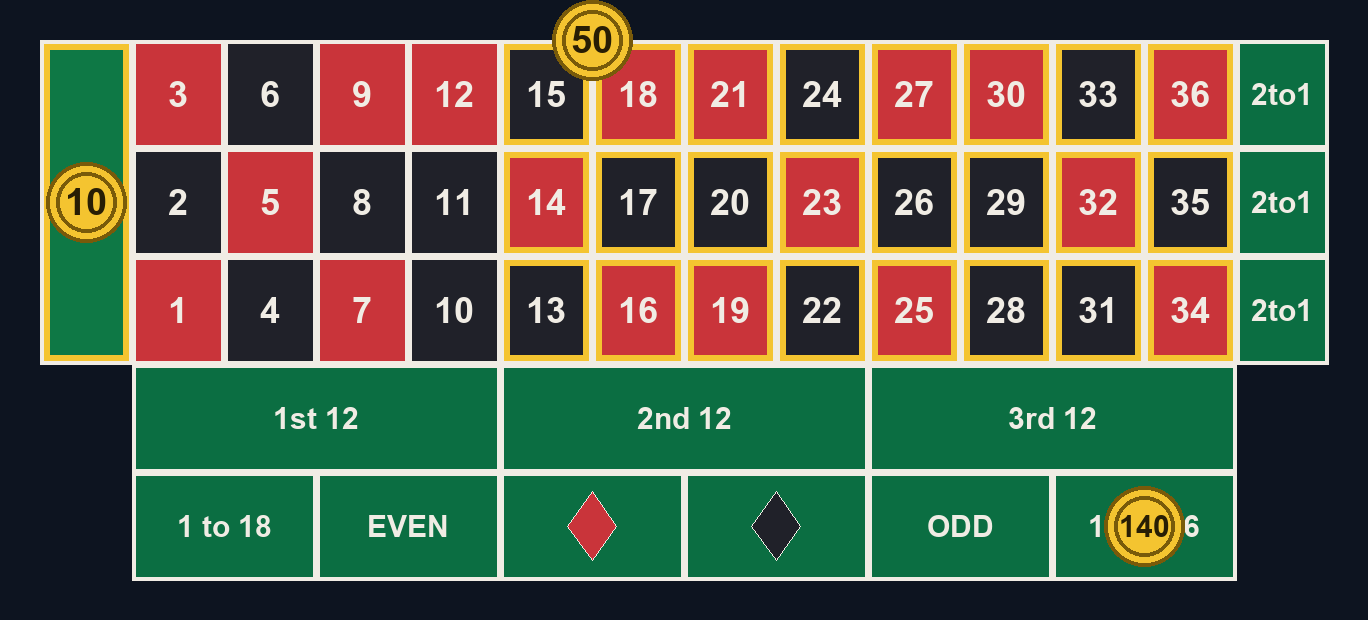
The method took its name from the literary figure of James Bond, but has nothing to do with the plot. The logic is to cover three parts of the wheel with one fixed amount, leaving the bottom dozen uncovered. The classic version is 200 units per spin:
- 140 units on the high numbers 19-36 (High bet, pays 1:1);
- 50 units on the 13-18 six line (double street, pays 5:1);
- 10 units on zero as a straight up bet (pays 35:1).
The unit is nominal: if the base denomination is 1 dollar, the round costs 200 dollars; if 10 cents, 20 dollars. The proportions between zones do not change, only the price of the spin, and the total bet per round is always 200 units.
Which numbers are covered and outcomes by zone
The three bets together cover 25 numbers: eighteen high ones (19-36), six middle ones (13-18) and zero. Only the first dozen, numbers 1 through 12, stays open. The table shows how much each zone brings, accounting for the returned stake and the loss of the other two parts of the layout.
| Zone | Bet | Payout | Numbers | Result per spin |
|---|---|---|---|---|
| 19-36 (high) | 140 | 1:1 | 18 | +80 |
| 13-18 (six line) | 50 | 5:1 | 6 | +100 |
| 0 (zero) | 10 | 35:1 | 1 | +160 |
| 1-12 (not covered) | - | - | 12 | -200 |
Let us work through the result on the high numbers. 19-36 comes up: the 140-unit High bet is paid 1:1, returning 140 plus a 140 win, 280 in total, while the six line and zero lose. Net profit is 280 minus the 200 staked, that is 80 units. For the six line, 50 units at 5:1 give a return of 300 and a plus of 100; zero at 35:1 returns 360 and a plus of 160. If a first-dozen number comes up, all three bets lose and the spin costs minus 200.
The probability of ending a round in profit is 25 winning numbers out of 37, about 67.6%. A loss falls on the 12 first-dozen numbers, about 32.4%. The high share of successful spins is what creates a false sense of reliability.
Why it is the first dozen that is left open
High covers the upper half, the six line adds six middle numbers, zero insures the green cell - with such a layout there is no room left for the first dozen. There is no point buying it in: the total bet and the losses to the house edge would grow, while the math would not improve. The price for the open zone is paid by these 12 numbers: when 1-12 comes up, all 200 units are lost at once, and one such spin wipes out the profit of two or three successful rounds. This asymmetry - frequent small pluses against rare large minuses - keeps the result in the casino's favor.
Why you need European roulette
The layout is designed for a single-zero wheel - European roulette with 37 cells, where the 10-unit bet on zero covers the only green cell. On the American wheel a 00 sector is added, left uncovered: besides the first dozen there appears one more losing number, and the house edge grows from 2.7% to 5.26%. That is why only single zero suits the James Bond system. How the field variants work and why the number of zeros matters is described in the article on roulette rules; before betting it is worth making sure the table is the European or French variant.
Expected value: minus 2.7% has not gone anywhere
The main misconception around the method is that covering 25 numbers reduces risk. Variance does drop, the result swings more gently, but the expected return is the same as for any other bet on the European wheel. Let us compute the expected value of a spin:
- 18 outcomes of +80: bring 1440;
- 6 outcomes of +100: bring 600;
- 1 outcome of +160: brings 160;
- 12 outcomes of -200: take away 2400.
The sum is minus 200 units over 37 spins, on average minus 5.41 units per round. Converted to the 200 staked, that is the very -2.7% built into zero. The chip layout does not change the rate: it is set by the design of the wheel. How the return depends on the number of zeros is in the overview of roulette sectors, and other systems and their math are in the breakdown of roulette strategies.
The progression version and why it is dangerous
The basic James Bond is a flat-bet: the amount per spin does not change. But an add-on is often seen where, after a loss, the player doubles the whole layout on the Martingale principle: 200, 400, 800, 1600 and so on, until a winning spin happens, to recover the accumulated losses in one round.
The problem is that losing spins do not come one at a time. Three in a row already require 1600 units on the fourth round, and a run of five or six failures hits the table limit or empties the bankroll. The probability of each loss, about 32%, does not depend on past results - the wheel does not remember previous numbers. Doubling does not raise the odds, it shifts all the risk onto one large spin that will hit the ceiling on bets. So the progression turns a method of moderate variance into a way to lose your deposit fast.
What bankroll you need
For the flat version the math is simple: a spin costs 200 units, and a losing streak can drag on. A reserve of 15-20 spins (3000-4000 units) lets you ride out a bad run. For the doubling version you need many times more, but it all runs into the table limits: the maximum bet will not let you double endlessly - one more argument against the progression.
An honest conclusion
The James Bond strategy is a way to structure a bet and cover most of the field with one layout, not a method to beat the casino. It gives many small pluses and rare large minuses, feels stable, but in sum stays at the same -2.7% return. The flat version is predictable and suits those who value gentle variance; the doubling version is dangerous for the bankroll.
How numbers and sectors are distributed on real tables with live dealers can be seen through open statistics: how long the first dozen, the high numbers or zero have not come up. This helps you assess the system soberly rather than on feelings.


