 Русский
 English
 हिन्दी
 Türkçe
 Español
 Deutsch
 Italiano
 Français
 Português
 Polski
 中文
 Bahasa Indonesia
 日本語
 বাংলা
 Tagalog
 Ελληνικά
 Български
 Svenska
 Tiếng Việt
 한국어
 Suomi
 Norsk
 Nederlands
 فارسی
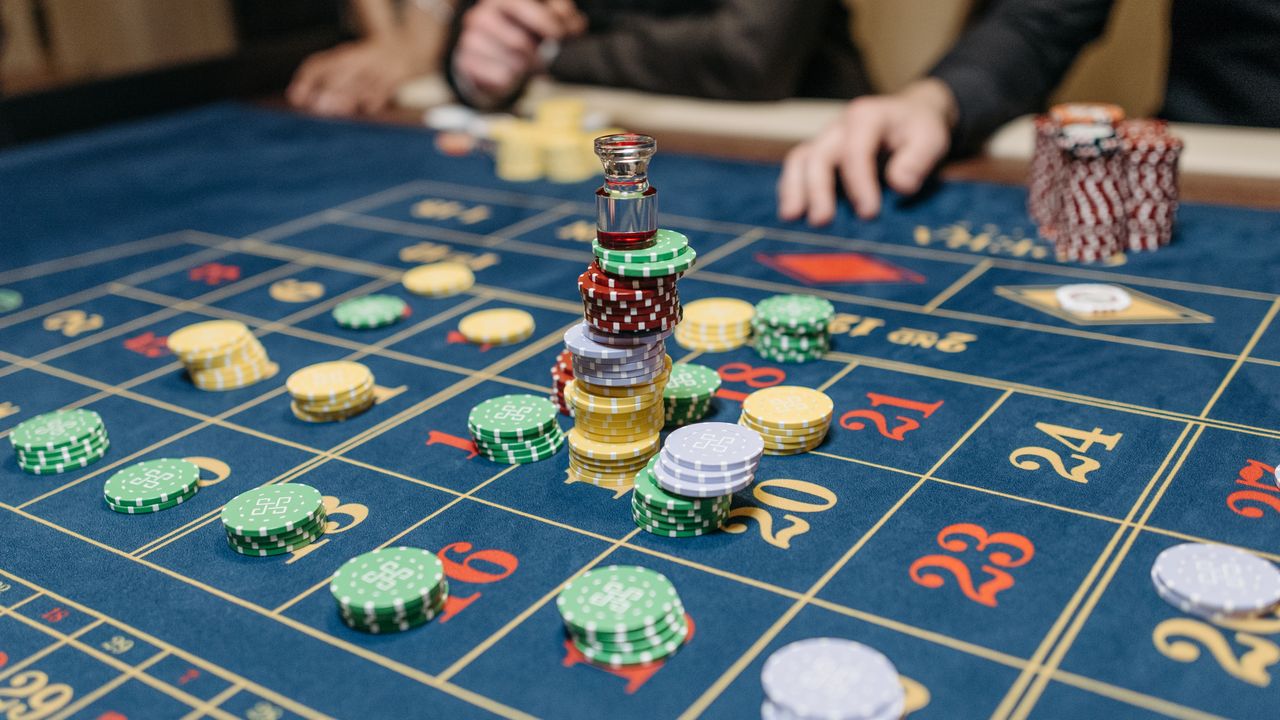
The authors of one YouTube roulette channel present another popular video strategy under the slogan of a '90% win rate': rare losses and almost constant returns. In reality this is the 24+8 system - a bet that covers 34 of the 37 numbers on the European wheel in a single spin. Let's break down how the chips are placed, why '90% wins' is misleading (most of the successful spins are a push, not a win) and why the expected value still stays at minus 2.7%.
What the 24+8 system is
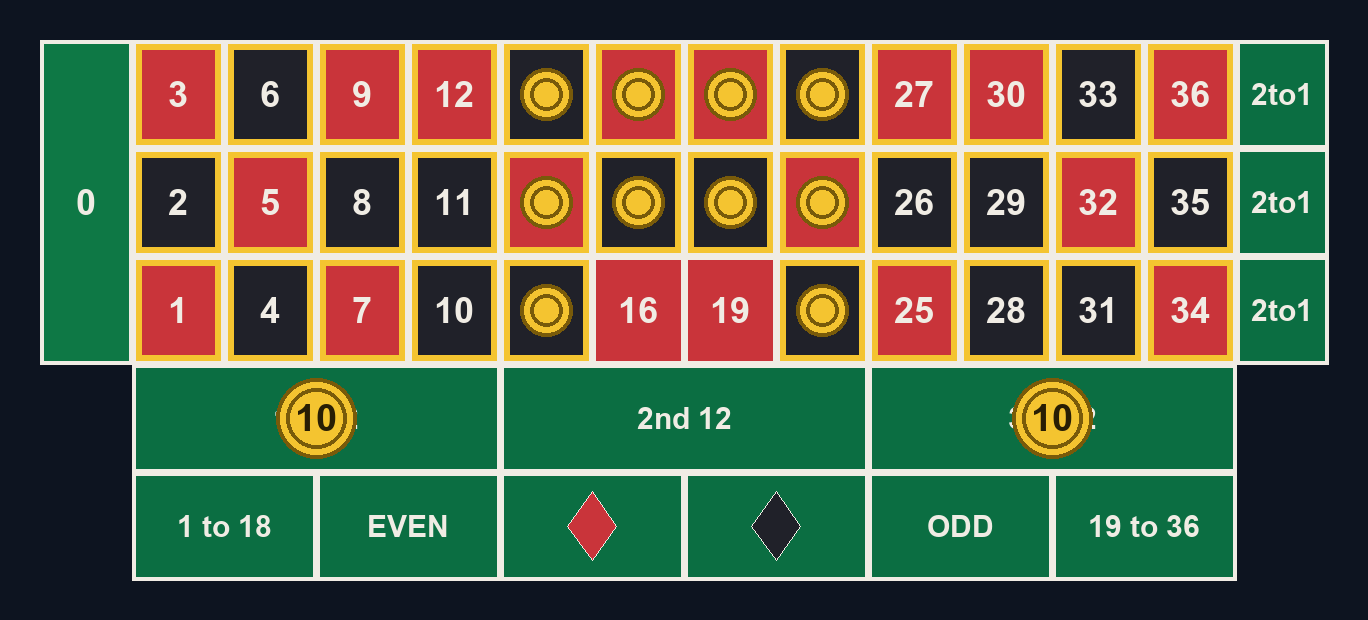
The name reflects the coverage: two dozens (24 numbers) plus a few numbers inside. The classic 30-unit layout is built from three parts: 10 units on the first dozen (1-12, paying 2:1), 10 units on the third dozen (25-36, 2:1) and 10 units as straight-ups on the numbers of the second dozen, except 16 and 19. That puts 34 of the 37 numbers under the bet, leaving only 16, 19 and zero uncovered. There is a separate article about the dozens and columns themselves.
Three outcomes, and only one is profitable
It is important to understand the payout structure, because it is not what it seems at first glance. Three outcomes are possible per spin:
- A second-dozen number you covered with a straight-up comes up (10 numbers): that number pays 35:1, both dozens lose, and the net result is plus 6 units.
- A first- or third-dozen number comes up (24 numbers): the winning dozen brings 20 units, but the second dozen and the inside bets are lost. That is exactly your 30 staked units back - a push, zero.
- 16, 19 or zero comes up (3 numbers): all bets lose, minus 30 units.
So real profit comes only from hitting the middle - 10 numbers out of 37. The other 24 'lucky' outcomes merely return the stake.
Why 90% is not 90% of wins
The authors cite a win rate of about 90%, and formally that is true: in 34 cases out of 37 you do not lose money, which is 89.2% on the European wheel. But 'not losing' is not the same as 'winning'. Almost two thirds of spins (24 of 37, about 65%) end in a push, and the bankroll does not grow. Profit comes only from the 10 middle numbers, while a rare loss on 16, 19 or zero takes away 30 units at once - as much as five middle hits bring in. Let's add up the expected value: (10 × 6 + 24 × 0 + 3 × (-30)) / 37 = (60 - 90) / 37 = -30/37, that is minus 0.81 units per spin on a 30-unit bet. In percentage terms that is 0.81 / 30 = 2.70% - the standard house edge on a single zero. The mechanics are the same as with Martingale: wide coverage redistributes the outcomes but does not cancel the edge.
The American wheel and why it is worse
The video is played on an American table with two zeros. There a 00 is added to the losing numbers: 16, 19, 0 and 00 become uncovered, that is four numbers, and the chance of not losing drops from 91.9% to 89.5%. The house edge on the double zero is 5.26%, almost twice as high. For this system, as for any other, the European wheel with a single zero is always more favourable.
Progression and bankroll management
To recover rare losses, Martingale is often added to the 24+8 system - doubling the bet after a loss. But a single loss here costs 30 units, and the doubling grows fast: 30, 60, 120, 240. Two or three losses in a row hit the table limit before the series has a chance to recover. It is safer to keep a flat bet, set a stop-loss and a win target in advance and leave after 8-10 spins, as the channel's authors themselves advise: win two or three times and walk away. The session bankroll is taken with a margin, and there is no trying to 'top up' after the limit.
How to track before you enter
Since profit depends on hits in the middle and on how often 16, 19 and zero come up, it helps to see up-to-date table statistics. In the roulette statistics section you can see, across all tables at once, the counters for how long numbers, dozens and sectors have not come up, in real time. This does not change the probabilities, but it helps to assess the system soberly and not mistake a run of pushes for a winning streak.
Conclusion
The 24+8 system looks almost reliable thanks to its coverage of 34 numbers, but its '90% wins' are mostly pushes, not profit. Real gains come only from the 10 middle numbers, while a rare loss wipes out several wins at once. The expected value stays at minus 2.7% on the European wheel. Treat it as a way to stretch out play with frequent returns, not as a source of income, and gamble responsibly.


